
Foy red heads.pair cinnamon teals
[IBLE] Re: [eBird Alert] Brown Pelican at Mann
hey Carl,
we’re not usually so high-maintenance, we promise!! ** sincere thanks ** for hanging with us via text, your notes of advice, etc…
glad we had plenty of water and snacks for entertainment….
after two hours of practicing patience 😉 the Brown Pelican flew in from somewhere north to the east side of Mann Lake to hang with the white pelican just below the model airplane area, but even then it kept disappearing behind the veg, seldom stayed out in the open, sheesh
congrats and thx to the original finder/reporter of this bird….!!
Larry and Missy
—– Original Message —–
From: ebird-alert@cornell.edu
To: “Larry Arnold”
Sent: Wednesday, June 12, 2019 3:06:36 PM
Subject: [eBird Alert] Needs Alert for Idaho
*** Species Summary:
Brown Pelican (6 Nez Perce)
———————————————
Thank you for subscribing to the
NOTE: all sightings are UNCONFIRMED unless indicated
Brown Pelican (Pelecanus occidentalis) (1) CONFIRMED
– Reported Jun 11, 2019 14:13 by kas dumroese
– Mann Lake, Nez Perce, Idaho
– Map: http://maps.google.com/?ie=UTF8&t=p&z=13&q=46.371455,-116.8511029&ll=46.371455,-116.8511029
– Checklist: https://ebird.org/view/checklist/S57297730
– Media: 1 Photo
Brown Pelican (Pelecanus occidentalis) (1) CONFIRMED
– Reported Jun 11, 2019 11:00 by Catherine Temple
– Mann Lake, Nez Perce, Idaho
– Map: http://maps.google.com/?ie=UTF8&t=p&z=13&q=46.371455,-116.8511029&ll=46.371455,-116.8511029
– Checklist: https://ebird.org/view/checklist/S57297606
– Media: 2 Photos
– Comments: “Appears to be juvenile bird. Also seen by Keith Carlson, Terry O’Halloran, Carl Lundblad”
Brown Pelican (Pelecanus occidentalis) (1)
– Reported Jun 11, 2019 10:20 by Keith Carlson
– Mann Lake, Nez Perce, Idaho
– Map: http://maps.google.com/?ie=UTF8&t=p&z=13&q=46.371455,-116.8511029&ll=46.371455,-116.8511029
– Checklist: https://ebird.org/view/checklist/S57305263
– Media: 1 Photo
– Comments: “Immature bird”
Brown Pelican (Pelecanus occidentalis) (1)
– Reported Jun 11, 2019 10:20 by Terry O’Halloran
– Mann Lake, Nez Perce, Idaho
– Map: http://maps.google.com/?ie=UTF8&t=p&z=13&q=46.371455,-116.8511029&ll=46.371455,-116.8511029
– Checklist: https://ebird.org/view/checklist/S57306508
– Media: 1 Photo
– Comments: “Immature bird”
Brown Pelican (Pelecanus occidentalis) (1)
– Reported Jun 11, 2019 10:20 by Catherine Temple
– Mann Lake, Nez Perce, Idaho
– Map: http://maps.google.com/?ie=UTF8&t=p&z=13&q=46.371455,-116.8511029&ll=46.371455,-116.8511029
– Checklist: https://ebird.org/view/checklist/S57311125
– Media: 1 Photo
– Comments: “Immature bird”
Brown Pelican (Pelecanus occidentalis) (1)
– Reported Jun 11, 2019 07:45 by Larry Hamrin
– Mann Lake, Nez Perce, Idaho
– Map: http://maps.google.com/?ie=UTF8&t=p&z=13&q=46.371455,-116.8511029&ll=46.371455,-116.8511029
– Checklist: https://ebird.org/view/checklist/S57295937
– Media: 2 Photos
***********
You received this message because you are subscribed to eBird’s Needs Alert for Idaho
Manage your eBird alert subscriptions:
https://ebird.org/alerts
[IBLE] BROWN PELICAN at Mann Lake
Keith Carlson, Terry O’Hallaron, Catherine Temple, and I are currently
watching a BROWN PELICAN at Mann Lake (east of Lewiston in Nez Perce
County) that was reported to and refound by Keith this morning. It’s
swimming around in the dense willows below the model airplane parking
area. It’s in immature plumage, so not yet sure if it’s identifiable to
subspecies. Will post photos later.
Many thanks to Keith for the prompt heads-up!
Good Birding,
Carl Lundblad
Moscow, ID
[IBLE] MacGillvrey’s warbler and possible Clay-colored sparrow on Kingfisher Trail, Canyon Co.
Found a MacGillvrey’s warbler near mp 0.3 and what may be a clay-colored
sparrow between mp 2 and 2.1. Very uncertain about the sparrow but had no
streaking on front and sang a very buzzy song. Clay-colored sparrow was the
closest match I coukd find using the Sibley app. Late migrants?
—
Louisa Evers
elouisa603@gmail.com
[IBLE] Least Flycatcher in Nez Perce County
On Saturday morning I found a singing LEAST FLYCATCHER near Mann Lake, east
of Lewiston in Nez Perce County. It was at the head of a brushy draw along
Bever Road about a mile east of the north end of the lake, at the location
of this eBird checklist: https://ebird.org/view/checklist/S57198806.
There are only about 3 previous Least Flycatcher records in eBird for Nez
Perce Co. A FORSTER’S TERN made a brief appearance at Mann Lake.
Good Birding,
Carl Lundblad
Moscow, ID
[IBLE] A Bigger Day
Yesterday I decided to do a longer ride, in the hope that some FOY birds
would pop up. I wasn’t disappointed. I started in Hulls Gulch and found 32
species before leaving. Mostly what you’d expect, including my FOY Blue-gray
Gnatcatcher (always a treat).
I then started my usual route along the greenbelt, but I wasn’t satisfied
with my results. So I decided to go to Hyatt Reserve, but only found a few
new birds and nothing spectacular (YHBB, AMCO, PBGR). So on my way back to
the greenbelt, I spied a pair of Arnolds, Larry and Missy to be specific.
They gave me some clues on where to find some birds I needed, not all of
which panned out. What did pan out was my FOY Willow Flycatcher. I also
checked out the Bald Eagle’s nest, hoping there were still occupants.
Fortunately, there were 2 full size immatures, both very dark, moving around
the nest. Once they start flying, I’m sure we’ll be hearing from non-birders
that they saw a Golden Eagle along the greenbelt. 😉
Final tally was 53 birds in 30 miles, not a “Big Day” but a fun “bigger”
day.
Tom McCabe, Boise
P.S. Today I found a Franklin’s Gull at Quinn’s Pond. I believe this is the
first time I have ever seen this species along the Boise River. I’ve seen
thousands elsewhere in Idaho, but this was quite a surprise. And just to be
sure it wasn’t a Bonaparte’s, I was able to get quite close when the bird
hung out along the shore next to the Whitewater Apartments. Only when I got
really close could I see the red of the beak. Ironically, I found almost as
many birds today (39) as yesterday, in half the miles (15). Go figure.
[IBLE] Chipping sparrow on Kingfisher Trail
Saw a chippie between mp 2.1 and 2.0 on the lake side of the trail. eBird
says this is a rare bird.
—
Louisa Evers
elouisa603@gmail.com
Re: [IBLE] Northern parula still around? [1 Attachment]
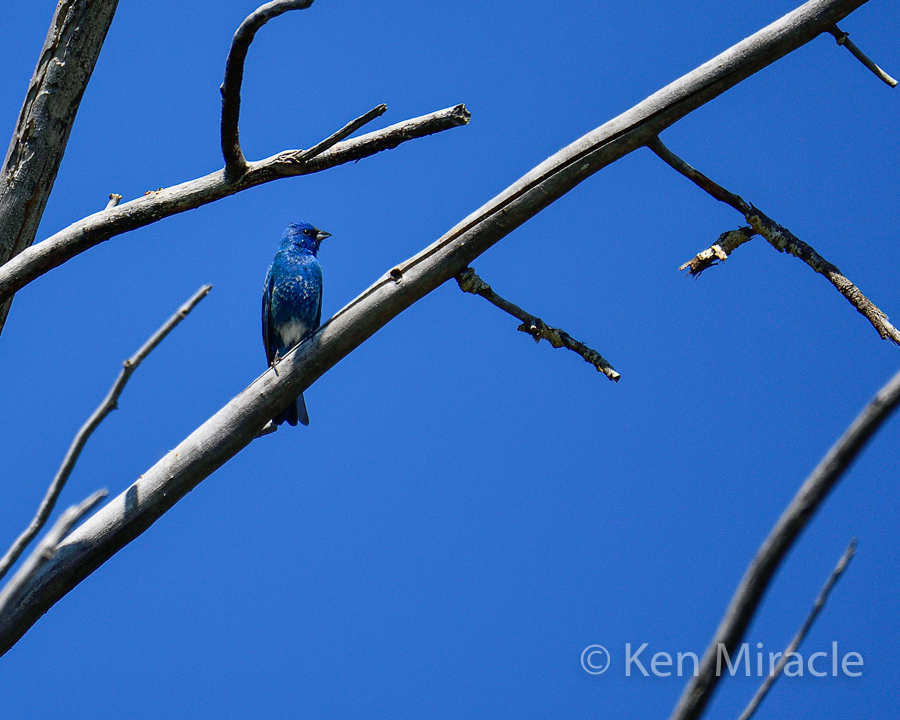
I was there between 10 and 12 this morning 6-4-19. There were three other birders in the area and none had seen the Northern Parula and were looking for the Indigo Bunting at milepost 1.5 -1.4.
After the other 3 left I returned to mile post 1.6 and found and photographed an Indigo Bunting at 11:30
I saw many other birds in the same area between 11:30 and noon but not a Northern Parula … they have a song I can not hear so no help for me in finding it with sound.
I saw one small bird fly by that seemed to have the right colors just after I had seen the Indigo fly past heading away from the path. The Indigo returned but the other smaller blue and beige bird did not.
> On Jun 4, 2019, at 2:09 PM, Louisa Evers elouisa603@gmail.com [ible]
>
>
> Has anyone seen this bird on Kingfisher Trail since Sunday (June 2)? I know it was seen in the morning. Also the indigo bunting has shifted to the area between mileposts 1.3 and 1.4.
> —
> Louisa Evers
> elouisa603@gmail.com
>
>
Ken Miracle
chukar28@icloud.com
208-908-9493
“Not that we are sufficient in ourselves to claim anything as coming from us, but our sufficiency is from God” 2COR 3:5
[IBLE] Northern parula still around?
Has anyone seen this bird on Kingfisher Trail since Sunday (June 2)? I
know it was seen in the morning. Also the indigo bunting has shifted to the
area between mileposts 1.3 and 1.4.
—
Louisa Evers
elouisa603@gmail.com
RE: [IBLE] Northern Parula still on Kingfisher trail. [3 Attachments]
Thanks to everyone, for posting the Parula and details lickety split! The Bunting was in same tree singing, a very birdy spot.
Cheers, Rich Rusnak, Nampa
6-2-19, mile marker 1.6 on Kingfisher trail at Deer Flat NSR
Sent from Mail for Windows 10
From: Cheryl Huizinga bchuizinga@cableone.net [ible]
Sent: Sunday, June 2, 2019 8:09 AM
To: ible@yahoogroups.com
Subject: [IBLE] Northern Parula still on Kingfisher trail.
Watching the NOPA at 1.6 mile marker on Kingfisher Trail on Deer Flat Refuge. Singing a lot. Cool bird!
Cheryl Huizinga
Cheryl Huizinga
Caldwell, Idaho