Re: [IBLE] Hummer Thoughts

Sorry folks, I hadn’t looked carefully enough at Bill’s graph.
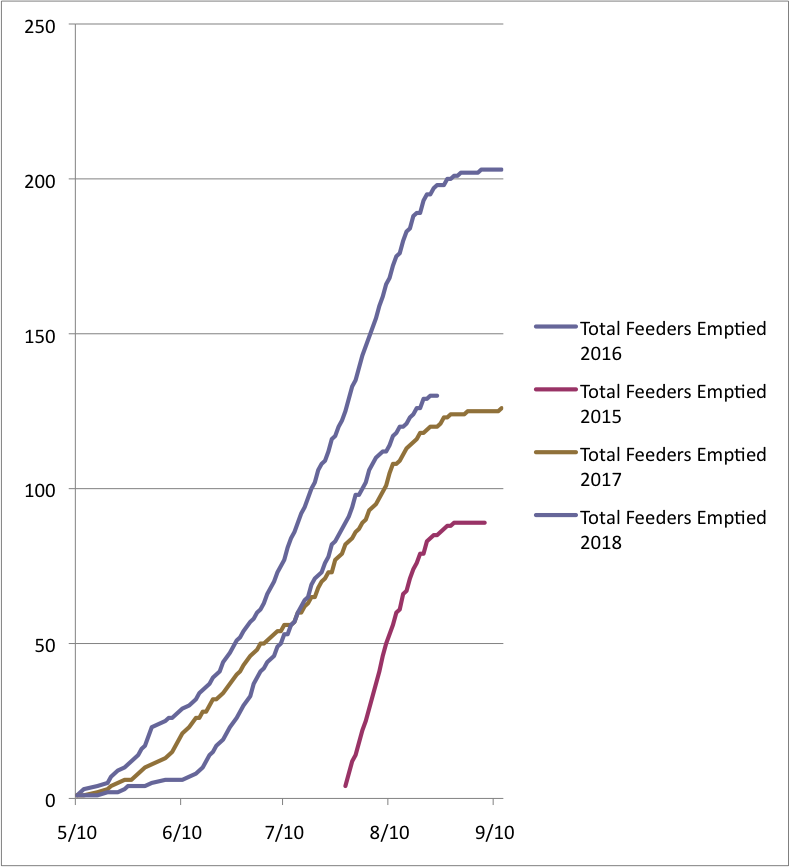
He just explained to me that 2016 was his Big Year, and I now see that 2018 is the not-yet-finished line graph……… eyiyi
Fun stuff =)

—– Original Message —–

From: “LARRY ARNOLD”
To: “Bill Moore”
Cc: “IBLE”
Sent: Friday, August 24, 2018 10:58:49 AM
Subject: Re: [IBLE] Hummer Thoughts [1 Attachment]

Bill,

Awesome note and graphic!! Sincere thanks for these!
It’s hard for me to tell a difference in color for the lines of 2016 and 2018… Is it safe to assume that 2018 is the highest line on your graph? That would certainly match what we’re seeing at our feeders this year. and BTW, our numbers are rapidly declining, just over the last couple of days. But I don’t mind having fewer feeders to wash and refill… 😉

Reminds me of a lady in Sonoita AZ who fed a LOT of hummingbirds (40+ years ago), and I must quote her: “The best two days of the year are when the first hummingbird arrives in spring and when the last one leaves in fall!”

Larry

—– Original Message —–

From: “Bill Moore hootowlbill@gmail.com [ible]”
To: “lcarrigan 55”
Cc: “IBLE”
Sent: Friday, August 24, 2018 8:18:35 AM
Subject: [IBLE] Hummer Thoughts [1 Attachment]

[ Attachment(s) from Bill Moore included below]

I continue to entertain all four species, but mostly females and juveniles. There are a few males, but not many. Of course there’s no missing the the rufous males. Fields are dry, but the watered flower beds are hit by them

I’m down to four feeders and the rates have dropped off a little. Past experience was they quit over the next few weeks.

I’d say be careful trying to count hummers by feeder sightings. We had a bander come up a couple years ago and he banded 60-70 in a little over an hour with only one repeat; all others came only once. The speedy fellows look alike. I think a better way to guess population is feeder depletion since basically only hummers and hornets hit my feeders.

I’m not sure how migration works up here. I don’t see a spike in solution depletion, but rather a fairly steady rate; maybe some leave, some new ones show up and the current hatches swap somewhat evenly.

I copied my feeder curves from last few years. We didn’t start keeping data til mid year in 2015. Sorry size is so big, but it was not easy for me to do it. You can see steady rates and totals of 4 cup feeders emptied.. Gotta go fill a feeder as I’m being scolded through the front window.

Bill Moore
Hoot Owl
Inkom

,_. ,
Re: [IBLE] Hummer Thoughts

Bill,

Awesome note and graphic!! Sincere thanks for these!
It’s hard for me to tell a difference in color for the lines of 2016 and 2018… Is it safe to assume that 2018 is the highest line on your graph? That would certainly match what we’re seeing at our feeders this year. and BTW, our numbers are rapidly declining, just over the last couple of days. But I don’t mind having fewer feeders to wash and refill… 😉

Reminds me of a lady in Sonoita AZ who fed a LOT of hummingbirds (40+ years ago), and I must quote her: “The best two days of the year are when the first hummingbird arrives in spring and when the last one leaves in fall!”

Larry

—– Original Message —–

From: “Bill Moore hootowlbill@gmail.com [ible]”
To: “lcarrigan 55”
Cc: “IBLE”
Sent: Friday, August 24, 2018 8:18:35 AM
Subject: [IBLE] Hummer Thoughts [1 Attachment]

[ Attachment(s) from Bill Moore included below]

I continue to entertain all four species, but mostly females and juveniles. There are a few males, but not many. Of course there’s no missing the the rufous males. Fields are dry, but the watered flower beds are hit by them

I’m down to four feeders and the rates have dropped off a little. Past experience was they quit over the next few weeks.

I’d say be careful trying to count hummers by feeder sightings. We had a bander come up a couple years ago and he banded 60-70 in a little over an hour with only one repeat; all others came only once. The speedy fellows look alike. I think a better way to guess population is feeder depletion since basically only hummers and hornets hit my feeders.

I’m not sure how migration works up here. I don’t see a spike in solution depletion, but rather a fairly steady rate; maybe some leave, some new ones show up and the current hatches swap somewhat evenly.

I copied my feeder curves from last few years. We didn’t start keeping data til mid year in 2015. Sorry size is so big, but it was not easy for me to do it. You can see steady rates and totals of 4 cup feeders emptied.. Gotta go fill a feeder as I’m being scolded through the front window.

Bill Moore
Hoot Owl
Inkom

,_. ,

[IBLE] Re: Hummer Thoughts

Thanks for the information, Bill. I like your graphic representation. We’ve never had the number of Calliopes as coming through now, usu only one or two a season. And, we never get your numbers of Rufous. Your banding season info is remarkable & shows that trying to pick out individuals is futile.

This AM has been exclusively Calliopes coming in. A couple have been subadult males. It’s fascinating to me that all these juveniles hitting the feeder now have some “genetic memory” of migration, as no adults are to be found. I also, haven’t seen an adult Black-headed Grosbeak in nearly a week, yet had 10 juveniles at once at my seed feeder this AM. All, of which, will head south on their own.

All I can say is, this hummingbird season is one for my books, anyway. Now, I am going to tear myself away & try to catch-&-release a certain Brown that’s been giving me fits for a week from his hideout under a cottonwood snag in the Snake.

Good Birding
Brian Carrigan
Blackfoot

[IBLE] RE: Why are birds singing in fall??

Hey Chuck, I hope you don’t mind me sharing this on IBLE, since it was such a perfect answer to the question! 😉
Folks, please see short poem at end of this piece…

Gracias amigo!
Larry

Wed, 12 Oct 2005

Autumn Winds

The mockingbird is singing. He’s been doing that for three weeks now. What’s he doing bursting into song all of a sudden in late September and keeping it up for weeks?

All over, animals in the parks are restless. Squirrels are madly digging up nuts from one place, carrying them to another and re-burying them. Chipmunks have appeared, chipping from the bushes as we walk by. I normally don’t see chipmunks in the local parks, just ground and tree squirrels. Are they always here, but usually quiet so we don’t see them? Or did they migrate in for the season?

An unusual species of large yellow-billed blue bird appeared on the wire above the house. How odd! What’s blue, jay sized but has a big bulky yellow bill?

Binoculars provided the answer. A scrub jay with an acorn in its bill! Since then I’ve seen quite a few yellow-billed Stellar’s jays in the local parks as well.

The central area of Alum Rock is filled with a large family of acorn woodpeckers drilling holes in trees, posts, and the walls of the Youth Science Institute building to store their acorns for the winter. The YSI building looks like swiss cheese. A few days after I saw the woodpeckers at work, we went back and the buildings had all sprouted dangling silvery tinsel from all eaves. It seems to be keeping the woodpeckers away. Bad for me (they’re cute), good for the YSI.

I saw a couple of nuthatches at Arastradero. A first for me. I don’t know if they’re migrants, or if they’re always there and I’ve just never noticed before. Arastradero was also thick with white-tailed kites. There are always a few testing the slope currents there, but this time I saw at least four different pairs, maybe more, each with their own territory staked out. Somehow even with that many kites they all managed to stay too far away for me to get a good picture.

The reason for all the time spent at Alum Rock and Arastradero is that we’re on the hunt for tarantulas. Every fall, just as the weather starts to get cold, the male tarantulas come out of their burrows and go marching across the trails looking for females. (Maybe the females are marching too. I’m not clear on that.) They’re only out for a short time — maybe a week — and they’re easy to miss. Last year we missed them altogether (but then we lucked out and spotted one later that month while travelling in Arizona).

Anyway, we’ve had no tarantula luck yet this year. Henry Coe state park had its annual Tarantula Festival already, a week and a half ago. But they always seem to have the festival while the weather’s still hot, long before tarantulas show up in any other parks. Maybe Coe tarantulas are a different species which comes out earlier than the others. At any rate, we’ve seen no sign of them at Alum Rock or Arastradero so far this year.

But back to that singing mockingbird. He doesn’t seem to be the same mocker who set up house here this spring and raised three nests of chicks. That one had a very distinctive call note which I haven’t heard at all this fall.

But what’s he doing singing in autumn? Is he singing as he packs his bags to fly to LA or Mexico? Or confused about the weather? Someone asked that on a local birding list, after noticing thrashers (closely related to mockingbirds) suddenly finding the muse. I reproduce here the edifying and entertaining answer. (Googling, it appears to have been a folk song, though I can’t find a home page for the author or anything about the music.)

The Autumnal Recrudescence of the Amatory Urge

When the birds are cacaphonic in the trees and on the verge
Of the fields in mid-October when the cold is like a scourge.
It is not delight in winter that makes feathered voices surge,
But autumnal recrudescence of the amatory urge.

When the frost is on the punkin and when leaf and branch diverge,
Birds with hormones reawakened sing a paean, not a dirge.
What’s the reason for their warbling? Why on earth this late-year splurge?
The autumnal recrudescence of the amatory urge.

Written by Susan Stiles, copyright December 1973

[IBLE] Hummer Thoughts [1 Attachment]

I continue to entertain all four species, but mostly females and juveniles. There are a few males, but not many. Of course there’s no missing the the rufous males. Fields are dry, but the watered flower beds are hit by them

I’m down to four feeders and the rates have dropped off a little. Past experience was they quit over the next few weeks.

I’d say be careful trying to count hummers by feeder sightings. We had a bander come up a couple years ago and he banded 60-70 in a little over an hour with only one repeat; all others came only once. The speedy fellows look alike. I think a better way to guess population is feeder depletion since basically only hummers and hornets hit my feeders.

I’m not sure how migration works up here. I don’t see a spike in solution depletion, but rather a fairly steady rate; maybe some leave, some new ones show up and the current hatches swap somewhat evenly.

I copied my feeder curves from last few years. We didn’t start keeping data til mid year in 2015. Sorry size is so big, but it was not easy for me to do it. You can see steady rates and totals of 4 cup feeders emptied.. Gotta go fill a feeder as I’m being scolded through the front window.

Bill Moore
Hoot Owl
Inkom

> ,_.,